Tether (USDT), the seventh most valuable crypto asset by market cap, has shrugged off attempts by newer stablecoins to usurp it. Now, a new version of tether is coming to the Tron network.
Tron is officially partnering with Tether to launch a TRC20-based version of the USDT stablecoin, according to a statement from both ventures. Adding the dollar-pegged coin to its blockchain is meant to elevate Tron’s existing ecosystem of decentralized applications (dapps), improve overall value storage, and increase its decentralized dxchange (DEX) liquidity. It is also said to make the network more accessible to enterprise-level partners and institutional investors. The companies expect to implement USDT on Tron by early Q2 2019.
“We are pleased to announce this collaboration with the Tron Foundation. This integration underlines our commitment to furthering innovation within the cryptocurrency space as we continue to anticipate the needs and demands of the digital asset community,” commented Jean-Louis van der Velde, chief executive officer of Tether.
Tokens Used for Stablecoins, Games, Torrents
TRC20 is a technical standard used for smart contracts on the blockchain for implementing tokens with the Tron Virtual Machine (TVM), similar to Ethereum’s ERC20. “Our collaboration with Tether to bring a USDT TRC20 token to Tron will bring incredible stability and confidence to users,” said Justin Sun, founder of Tron and CEO of Bittorrent. “As we perform and execute on our vision, they can easily redeem their tokens for US dollars.”
In the Daily on Monday we reported that Tron Arcade and Mixmarvel have teamed up to bring the online game Slither.io to the blockchain. Hypersnakes, the blockchain version of the multiplayer worm-like game, allows players to compete and earn TRX without a wallet, making it easier to acquire the cryptocurrency. The Bittorrent token (BTT) is another example of a digital coin based on the Tron protocol.
What do you think about Tron partnering with Tether? Share your thoughts in the comments section below.
Over the last few days, cryptocurrency markets have been holding steady and consolidating after the correction on Feb. 24. Currently, the entire market capitalization is hovering around $129 billion and trade volume has started to diminish slightly with $24.9 billion traded over the last 24 hours. The top contenders capturing most of today’s daily gains consist of litecoin (LTC), binance coin (BNB), and ethereum classic (ETC).
Crypto Markets Consolidate While Traders Wait for the Next Big Move
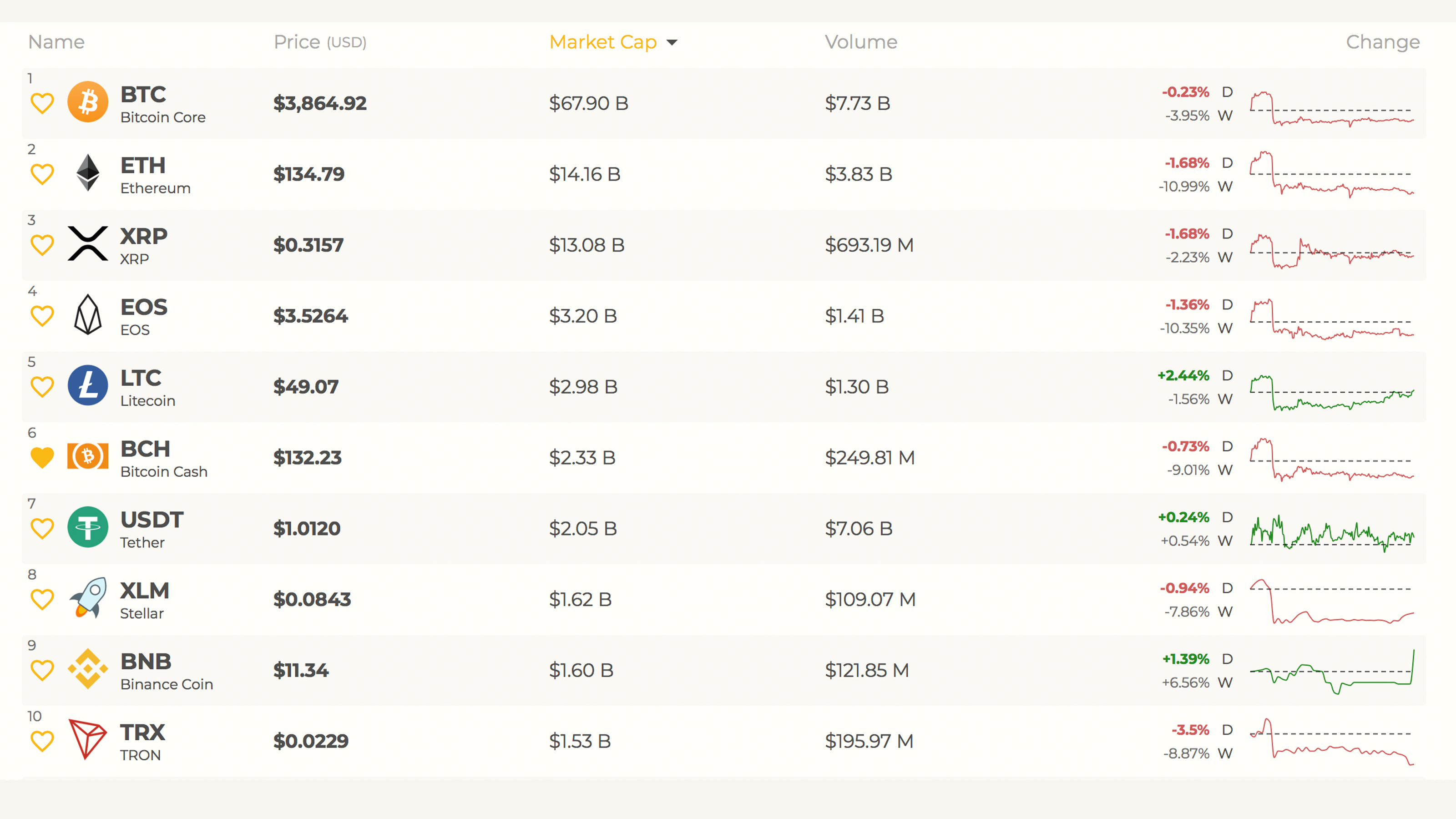
On Saturday, March 2, the most popular crypto markets have been dull after the last big price dip that took place last week. Today the three coins swapping the most volume are bitcoin core (BTC), tether (USDT) and ethereum (ETH). At the moment BTC is swapping for $3,864 per coin and has an overall market valuation of $67.9 billion. This is followed by the second largest market valuation held by ethereum (ETH) which is trading for $134 per token.
Top 10 cryptocurrencies on March 2, 2019.
Ethereum had been the rally leader about a week and a half ago but markets are down over 10% for the week. Ripple (XRP) currently holds the third position today and each XRP is swapping for $0.31 a coin. This is followed by eos (EOS)markets which are down 10% over the last seven days as well. One eos is trading for $3.53 this Saturday and the market has an overall valuation of around $3.2 billion. Lastly, litecoin (LTC) is leading the top five markets by gaining 2.4% over the last 24 hours. One LTC is trading for $49 and markets have only lost 1.56% last week.
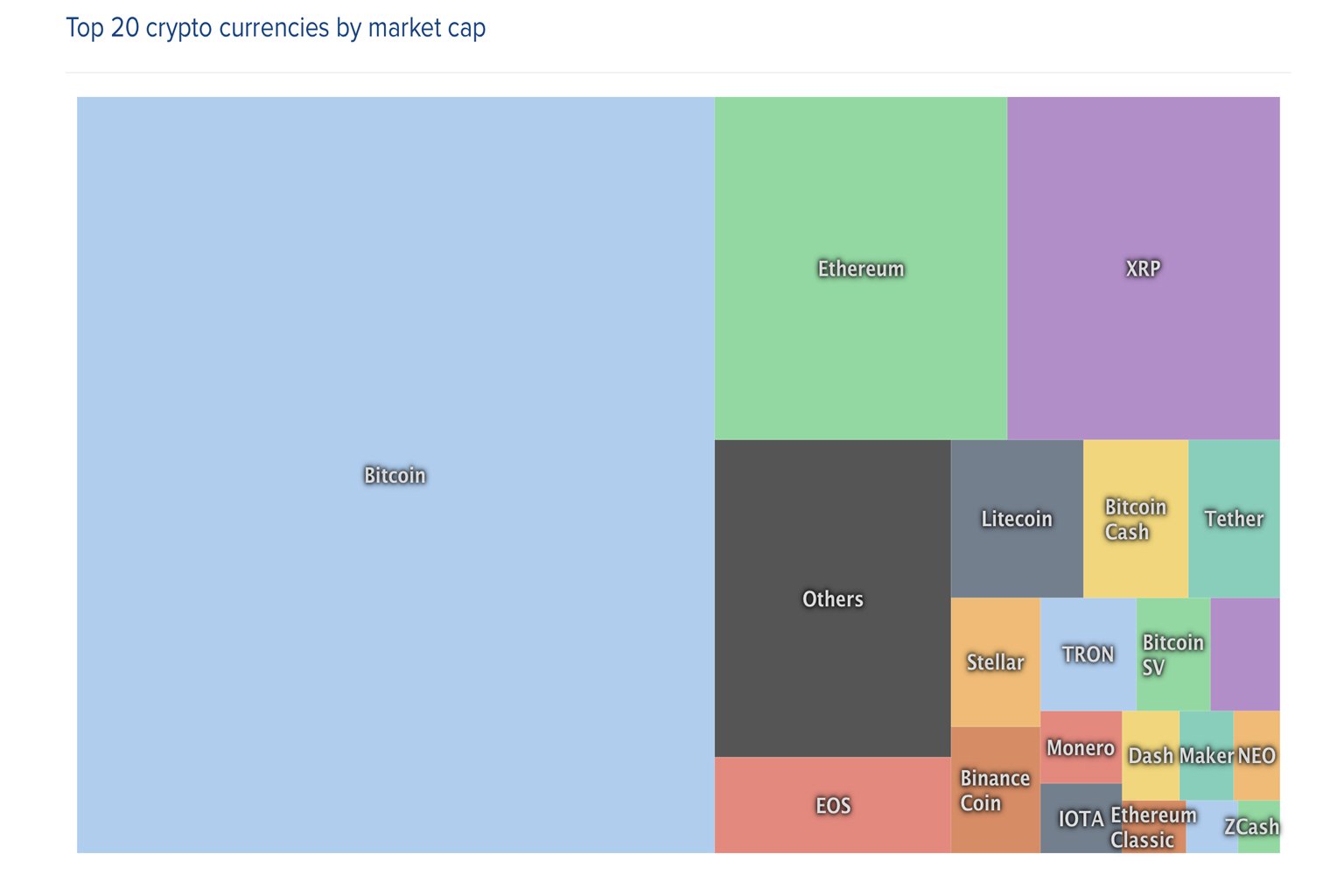
Top 20 cryptos by market capitalization on March 2, 2019.
Bitcoin Cash (BCH) Market Action
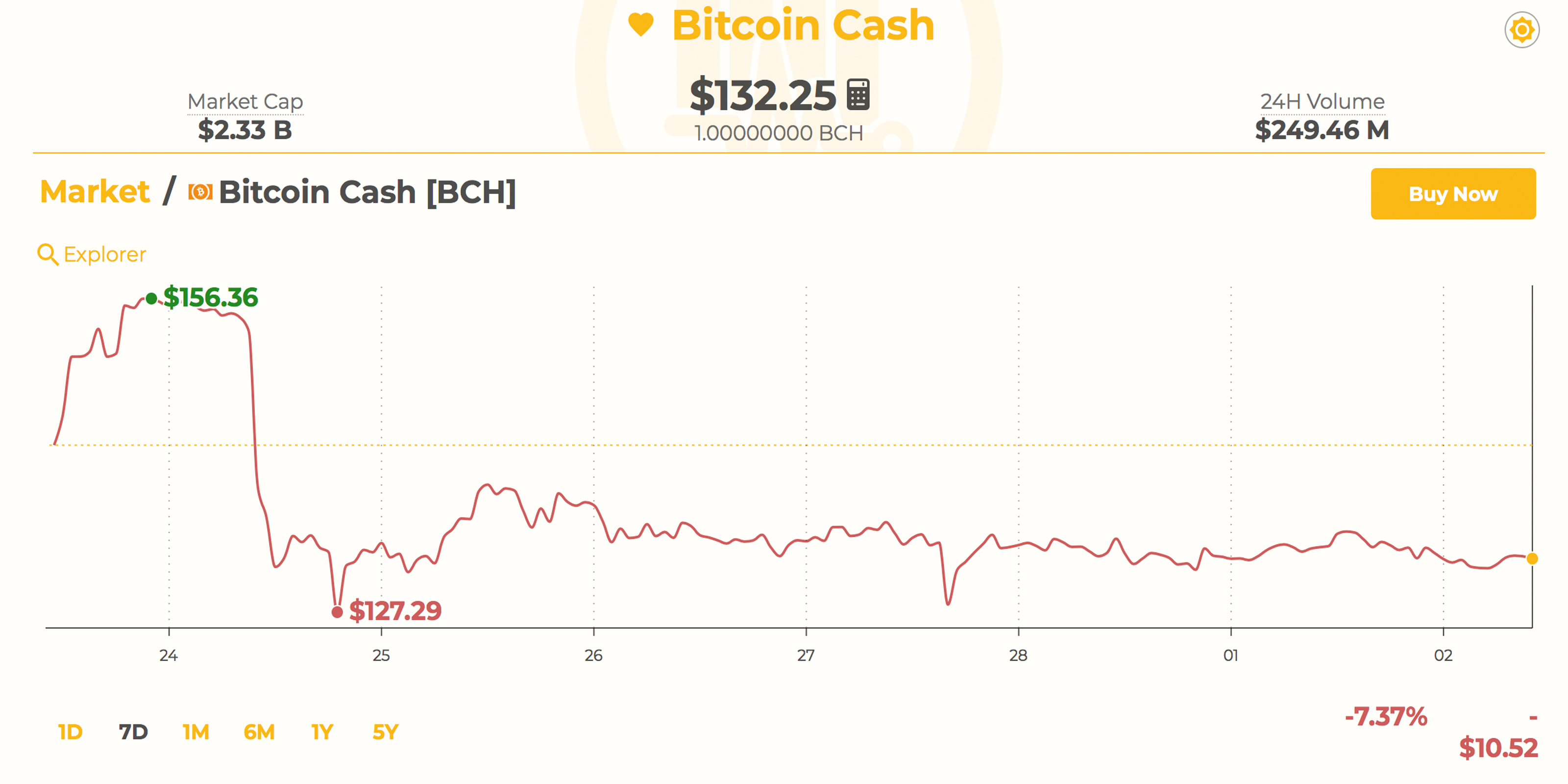
Bitcoin cash (BCH) markets are down this Saturday 0.73% and down over 9% in the last seven days. BCH is trading for $132 at press time and has a market capitalization of around $2.33 billion. This weekend BCH is the eighth most traded coin, below neo and just above dash.
BCH/USD 7-day on March 2.
Currently, there is $249.6 million worth of BCH swapped among the most popular exchanges and ETH is capturing 43% of that volume. Pairs following ETH’s dominance with BCH include USDT (31%), BTC (16.5%), USD (4.3%), KRW (3.3%), and JPY (0.4%). The top five exchanges trading the most BCH this weekend are Lbank, Bitmart, Binance, Fcoin, and Bibox. Last week, before the Feb. 24 dump, BCH failed to break upper resistance above $145 per coin and foundations have been meandering around $128-135 since then.
BTC/USD Poloniex 4-hour chart on March 2, 2019.
BCH/USD Technical Indicators
Looking at the four-hour chart on Kraken and Bitstamp shows that even though there was a slight correction last week, things still look optimistic. An indicator that’s been revealing this trend is the fact that while BCH has been consolidating, the short-term 100 Simple Moving Average has crossed the long-term 200 trendline. This shows that the path toward the least resistance at least for now is toward the upside. BCH did spike above the $128 zone after the quick drop and the consolidation has reinforced a bullish outlook.
BTC/USD Kraken 4-hour chart on March 2, 2019.
However, Relative Strength Index and Stochastic oscillators are meandering in the middle, showing indecisiveness among traders. Yet the MACd histogram shows room for improvement and it could start ascending after some resistance is broken this weekend. Order books still show that upper resistance is still around the $145 zone and from there, seas are much smoother. On the backside, if bears take the reins again they will be stopped between the current vantage point and $110.
The Verdict: Public Interest Is Waning But New Money May Not Be Needed to Ignite Next Bull Run
Overall traders are still uncertain, but a good portion think crypto markets may be near the elusive bottom. There are a few signals from both technical charts and overall positive news that could spark a price jump, although the month of March is well known for being a lackluster trading month for cryptocurrencies. Another obstacle is the fact that interest is waning as Google trends show that people searching for terms like “bitcoin price” “bitcoin” bitcoin cash” “ethereum” and “cryptocurrency” just isn’t happening as much as it was a year ago.
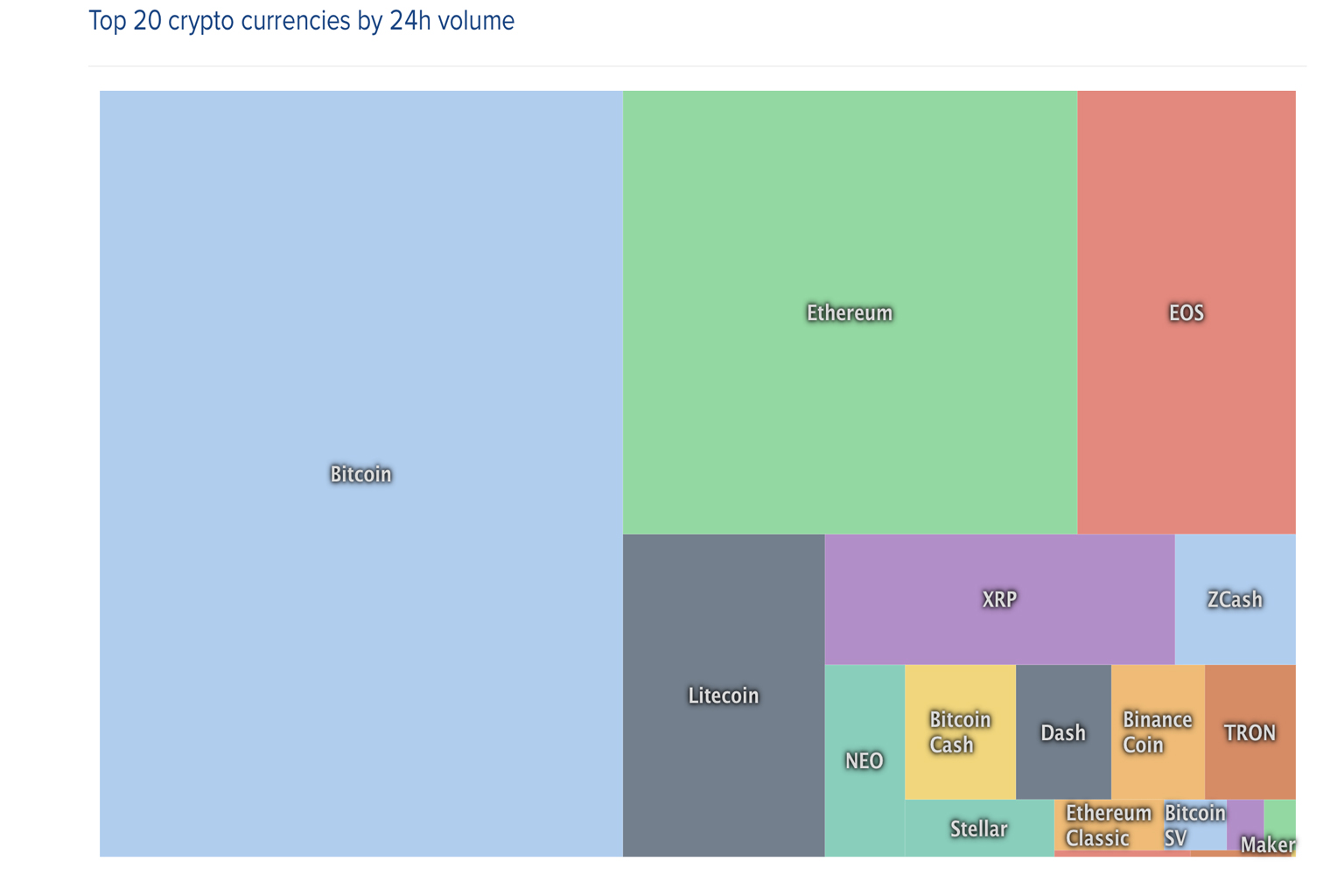
The top 20 cryptocurrency volumes on Saturday, March 2, 2019.
This gives investors the indication that “new money” just isn’t coming in, however, some analysts believe this doesn’t matter. For instance, the Singapore-based Three Arrows Capital CEO Su Zhu says there’s enough money sitting in crypto right now to initiate a price spike.
“There’s an estimated $2 billion in cash sitting in crypto funds. There’s another $2 billion+ sitting in stablecoins, and another $2 billion sitting at exchanges, silvergate, signature,” Su Zhu explained to his Twitter followers.
Zhu added:
This is $6 billion in fiat already onboarded to crypto to buy your bags — Imagine thinking we need new money to hit $10k.
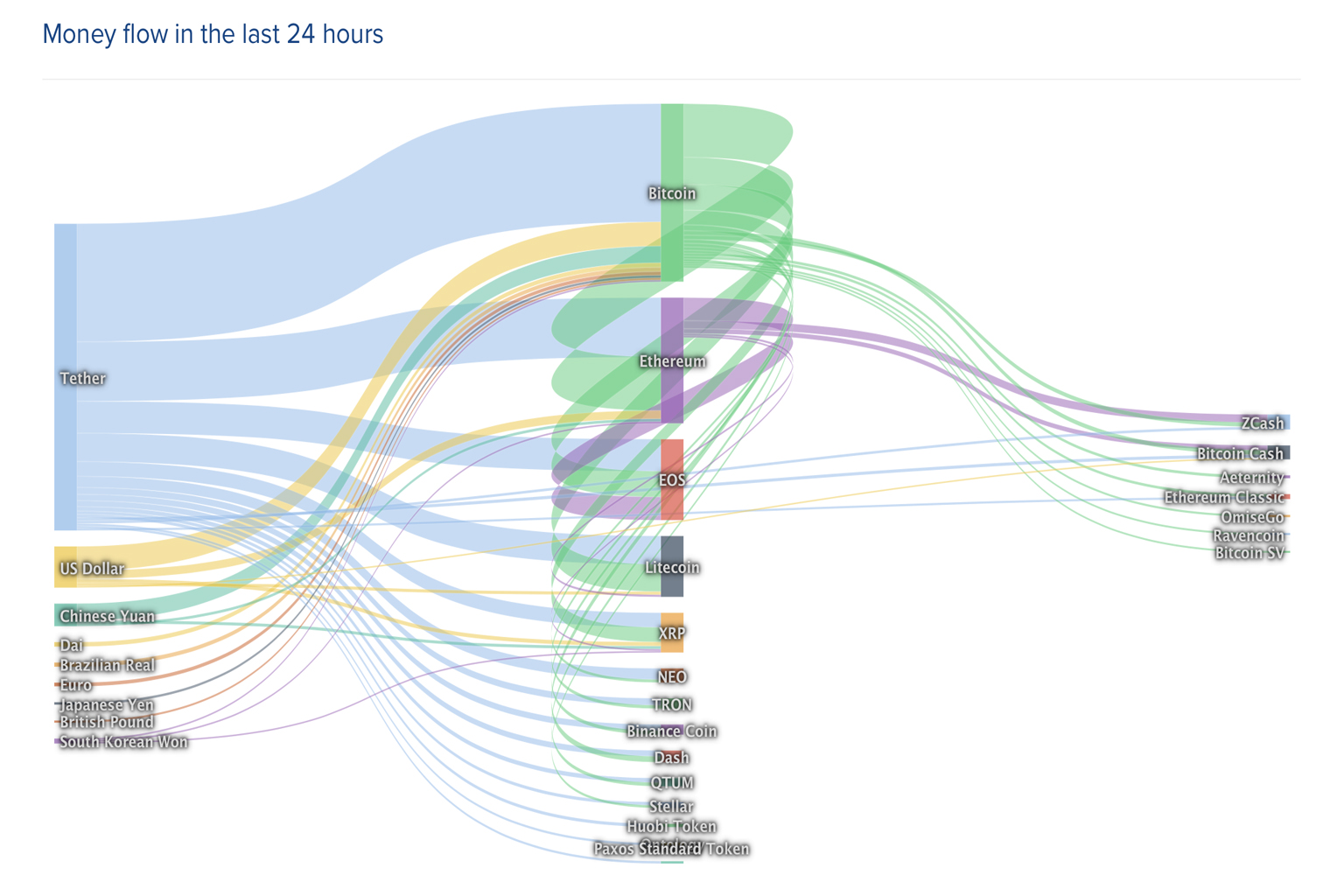
Cryptocurrency money flows on March 2, 2019. USDT volumes confirm Su Zhu’s theory of $6 billion in fiat already onboarded to crypto.
Another indicator of positivity is the amount of bitcoin short positions dropping extremely low on exchanges like Bitfinex and Bitmex. The same can be said of ethereum short positions as a few weeks ago they reached all-time highs, but have since reversed considerably. These signs indicate that traders are uncertain the price will be heading lower and are waiting for the next big move for better insight.
Where do you see the price of BCH, BTC, and other coins heading from here? Let us know in the comments below.
Disclaimer: Price articles and markets updates are intended for informational purposes only and should not to be considered as trading advice. Neither Bitcoin.com nor the author is responsible for any losses or gains, as the ultimate decision to conduct a trade is made by the reader. Always remember that only those in possession of the private keys are in control of the “money.”
Tags : #Binance Coin in future #Binance Coin Prediction
In this edition of The Daily, Bitmex has updated its Terms of Service. The revised rules prohibit residents of certain countries, including the U.S., from trading digital assets on the platform. Also, the native token of the leading crypto exchange Binance, BNB, has hit a record price against BTC. And in Malta, companies from the crypto industry are facing limited access to banking services.
Digital asset exchange Bitmex has updated its Terms of Service this week introducing significant changes to the agreement. Users from a number of countries, including the United States, Cuba, Syria, North Korea, and Sudan won’t have access to its services in the future. The restrictions also apply to residents of the Canadian province of Quebec as well as traders from the Autonomous Republic of Crimea and the Federal City of Sevastopol in the Russian Federation.
The Seychelles-based operator of the platform, HDR Global Trading Limited, has informed all such residents that holding open positions and entering into new contracts on Bitmex from their respective jurisdictions is not allowed. The exchange also reserves the right to immediately close the accounts of such clients and liquidate any positions they may have opened.
The new agreement is noticeably longer than the old version, with added texts regarding the platform’s access conditions and the accuracy and availability of service, Cryptoglobe reported. Other new provisions concern trading fees as well as the protection of data and intellectual property. The upcoming ban for residents of the U.S. and Quebec was announced in January of this year. The updated terms of service will come into effect on March 6.
Binance Coin Hits Record High Against BTC
Binance coin (BNB), the native token of the largest crypto exchange by daily trading volume, has set a new record against bitcoin core (BTC). At approximately 17:55 UTC on Friday, March 1, its price reached 0.00299880 BTC and a high of $11.61 in fiat.
BNB’s market cap now stands at $1.58 billion. The previous record high for its price against BTC was registered on Feb. 11 this year. The crypto reached its all-time high against the U.S. dollar on Jan. 12, 2018 when it was trading for almost $25. The latest spike comes after the company announced a program for traders willing to test its new decentralized trading platform.
Crypto Companies Struggle to Open Bank Accounts in Malta
Malta’s crypto-friendly regulatory framework has attracted dozens of businesses from the crypto and blockchain industry to the island. However, according to a new report, many of these companies are experiencing difficulties when they try to open accounts with local banks.
Sources from service providers, legal firms and finance companies, quoted by the Times of Malta, claim that banks have been declining to work with these entities stating this business is outside their “risk appetite.”
The Parliamentary Secretary for Financial Services, Silvio Schembri, told the publication he is currently holding talks with different banks and other stakeholders in an effort to resolve the issue and improve the understanding of the industry. The official noted that banks are often waiting for crypto operators to obtain a license from the Malta Financial Services Authority (MFSA) before opening the doors for them.
No less than 28 applications for registration under Malta’s Virtual Financial Assets Act have been filed with the MFSA since the end of November. The regulator plans to issue its first licenses by the end of this quarter.
What are your thoughts on today’s news tidbits? Tell us in the comments section.
A Stanford student has submitted a letter of complaint to the Graduate School Board stating that a resident economics professor grossly misrepresented Bitcoin during a guest lecture on blockchain and the future of finance, while openly promoting Ripple as a better alternative.
When Stanford student Conner Brown entered a lecture hall at the Stanford Graduate School of Business in January 2019 to attend a guest lecture by Susan Athey, Economics of Technology Professor at Stanford, he got more than he bargained for. So much so that he felt compelled to write the school board:
During the presentation from Dr. Athey there were multiple misstatements that were concerning to me. I understand that she is a respected professor at Stanford and that these may have been accidental; however I also believe that it is in the best interest of our academic environment that we ensure high caliber discussion and peer review.
He added: “My concerns revolve around misstatements around Bitcoin in comparison to Ripple’s token called XRP. I would also like to raise concerns about potential conflicts of interest in a professor making false statements while simultaneously promoting a product that claims to solve these problems and being paid by that company.”
The lecturer in question is an acclaimed economist who’s previously held a chair at Harvard. The highly cited professor, tasked with teaching an upcoming course in cryptocurrencies at Stanford University, might have been assumed to be an expert in her field.
Her decision to shill Ripple while criticizing Bitcoin has been attributed not to ignorance, but to the fact that she sits on Ripple’s Board of Directors, which she joined back in 2014.
Posted below is an email that I sent to the Stanford GSB after a presentation in one of my classes. My professors refused to talk in person after bringing this to their attention. Over a month later I still have heard no response, other than "we will get back to you on this."
In his letter, which reads like a college-level introduction to Bitcoin, Conner Brown articulates the points where Athey’s presentation was misguided. These arguments include:
Conflating mining nodes and full validating nodes on the Bitcoin network and thus claiming that Bitcoin is “controlled by a small group of miners in China.”
Claiming that Bitcoin accounts are “secured economically and not cryptographically.”
Claiming that “Bitcoin wastes electricity by stealing from rivers to solve useless math problems.”
Claiming that Mexican financial institutions are using Ripple technology.
Claiming that Ripple does not sell XRP, they only “routinely disperse” the token.
Showcasing outdated bitcoin wallets from circa 2013 without mentioning ensuing technological advancements.
Claiming that if you enter the incorrect Bitcoin address, the funds disappear without mentioning that modern wallets have QR code functionality to prevent this.
Athey’s slide on an XRP use case, for which Brown says he could find no corroborative evidence.
Brown proceeded to debunk each statement in turn, citing well-known research and research papers. Being a diligent student of Bitcoin and of life, he really did his homework:
I called the company that Ripple has publicly stated uses the technology and asked them if they use “xRapid” or any services provided by Ripple, their response was “No.” I’ve attached the audio clip below.
With Great Commercial Power Comes Great Academic Responsibility
To chalk up Athey’s blunders to innocent — even ignorant — mistakes would seem impossible given that he’s an economist at one of the most prestigious universities in the world, lecturing on a topic she’s meant to know a lot about. Athey has been on Ripple’s Board of Directors for the past five years, a company she’s proud to be associated with:
…all of those problems can potentially be addressed, and indeed startups are working on all of them within the Bitcoin community. However, it made me wonder whether there wasn’t a simpler way to solve this problem, one that still took advantage of the fundamental innovation from Bitcoin, a secure ledger. As I was grappling with these questions, I learned about the Ripple protocol. I realized that it addressed all of these problems.
Worse still, her promotion of XRP within an academic setting doesn’t appear to be the first time, as this Twitter user mentions:
Posted below is an email that I sent to the Stanford GSB after a presentation in one of my classes. My professors refused to talk in person after bringing this to their attention. Over a month later I still have heard no response, other than "we will get back to you on this."
Very well written points. i heard her speak last year at uchicago and also mentioned some ripple comments at the time which I thought were questionable. Thank you for speaking up.
In the face of what appears to be a blatant promotion of an altcoin she has a vested interest in, Athey has brought not only her own but also Stanford’s academic integrity into question.
Ripple’s Blockchain Initiative Program, which has entered schools, sounds eerily in tune with what Brown and his classmates experienced. As the company’s SVP of Global Operations Eric van Miltenburg describes it:
We are placing full faith in these universities, knowing that the students and faculty are the most capable individuals in the field. We want to help accelerate what is already a spark by turning that into a flame to help these schools move forward.
Ripple Is More Relevant Than Bitcoin
A month after receiving no response to his letter from Stanford, Brown took to Twitter to relate his experience.
Posted below is an email that I sent to the Stanford GSB after a presentation in one of my classes. My professors refused to talk in person after bringing this to their attention. Over a month later I still have heard no response, other than "we will get back to you on this."
Hi Dr. Athey, thank you for responding! You are correct—this email was sent to the professors hosting your talk. I’m sorry they didn’t follow up with you.
If you disagree with content in my letter, could you publicly post the slides from the talk?
Here are my slides. Unlike what you might think from Conner's post, the lecture and slides are very high level, intuitive, as this was MBA class with no background in blockchain. Just trying to give the big picture as well as some of the challenges. https://tinyurl.com/y6rx6so6
...actual, production-grade, beta-stage, daily-used, working Lightning Network layer itself in the comparison, the most relevant thing in the whole research field to discuss in a topic about confirmation times (not to mention costs & privacy) for e-commerce & payments, ...
The slides are all describing Bitcoin early days and ~10 min was approx. The talk begins with stripped down, basic tech, basic wallet, no bells/whistles, high level. Not intending to take any stand on today's performance or lightning or any current debates!
You have to be more self aware than that. If the only counter to Bitcoin you’re going to talk about is Ripple, which is tied to a private company that you’re on the Board of Directors of, maybe toss in a slide about Stellar or EOS to save yourself some grief.
Point taken. But, in MBA class, guest speaker is *supposed* to talk about what they personally know. This class about future of finance; Ripple is natural since it has bank/FI customers. I had multiple slides on smart contracts, discussed Ethereum etc.
Whatever Athey’s intended agenda, with cryptocurrencies increasingly placed on the curriculum of tertiary institutions, it’s of utmost importance that a faculty’s representation of the technology is fair, equal, and unbiased. On this occasion, there would appear to be a prima facie case for asserting that the professor overstepped the mark.
What’s your take on Brown’s criticisms of Athey’s lecture? Let us know in the comments section below.
Tags : #Ripple will replace Bitcoin #Ripple for Bank #What is Ripple