Showing posts with label Featured. Show all posts

Thursday, February 28, 2019

Honest Cash Publishing App Sees Organic Growth and New Features


Last November, a new Bitcoin Cash-powered publishing platform was launched called Honest Cash after the blogging site Yours.org opted to follow the BSV chain following the blockchain split. Since then, the Honest Cash application has seen significant growth, new features, and a custom SLP-created coin called the Honest Cash Token (HCT).

Bitcoin Cash Social Media App Honest Cash Grows Bigger Every Month

The BCH-centric publishing platform for content creators Honest Cash has seen a lot of changes in the last four months. In November, the project was initially launched by Adrian Barwicki, a programmer and the creator of the Panda Suite software development kit (SDK). Since the launch, the publishing application Honest Cash has seen a bunch of growth and Barwicki is still keeping signups at bay by utilizing an invite-only mechanism for registration. News.Bitcoin.com tested the platform when it first launched by being one of the first 100 activated accounts but since then the platform has gained a total of 1,184 users. According to the team, Honest Cash is getting around 5,000 visitors per month and traction is growing.
“In the first 2 weeks of February, Honest Cash has got more new users than in November, December and January, respectively,” explained Honest Cash’s Adrian Barwicki.
Honest Cash Publishing App Sees Organic Growth and New Features
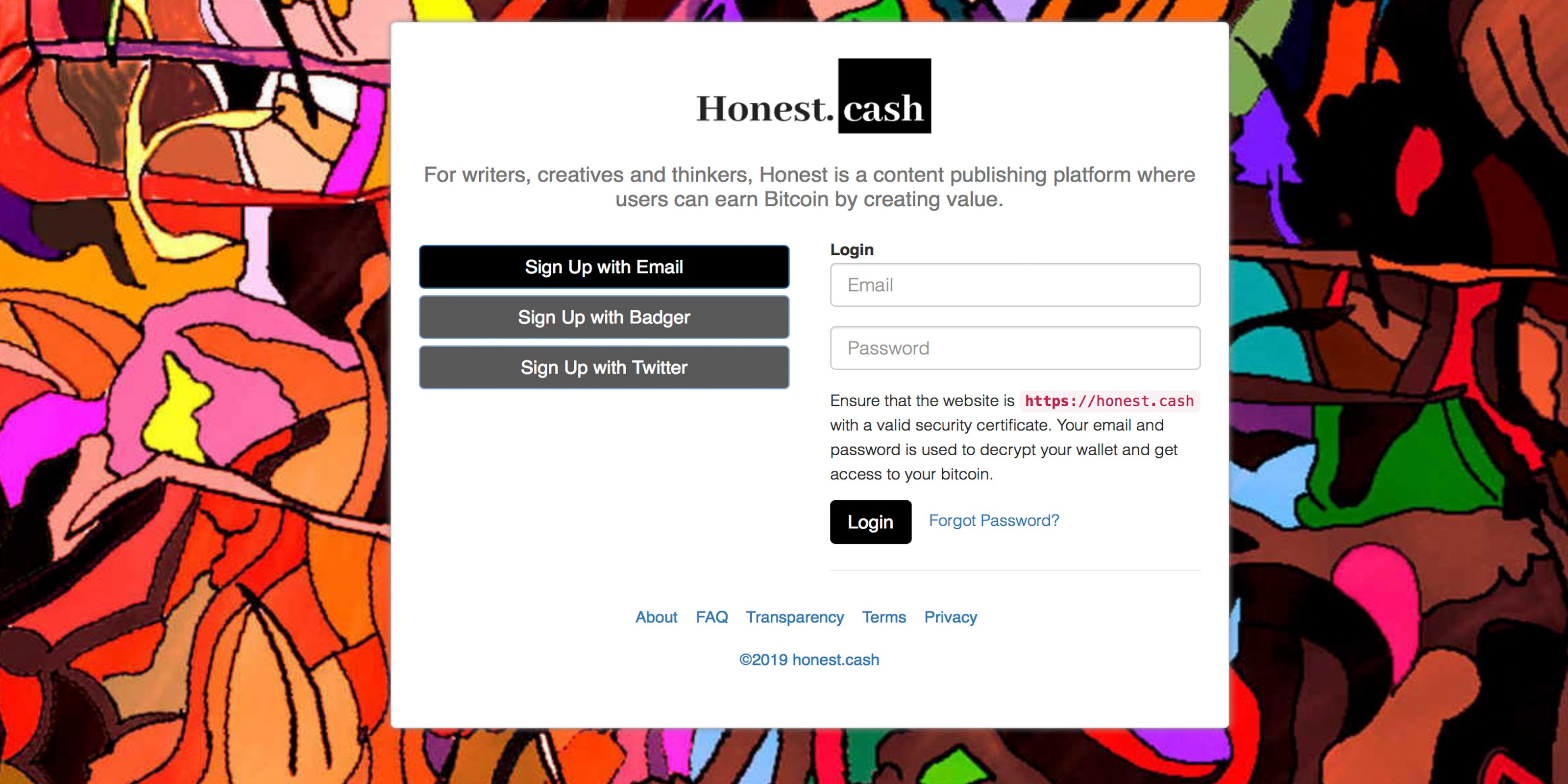
Soon Honest Cash users will be able to sign up with their Twitter handle or by using the Badger Wallet.
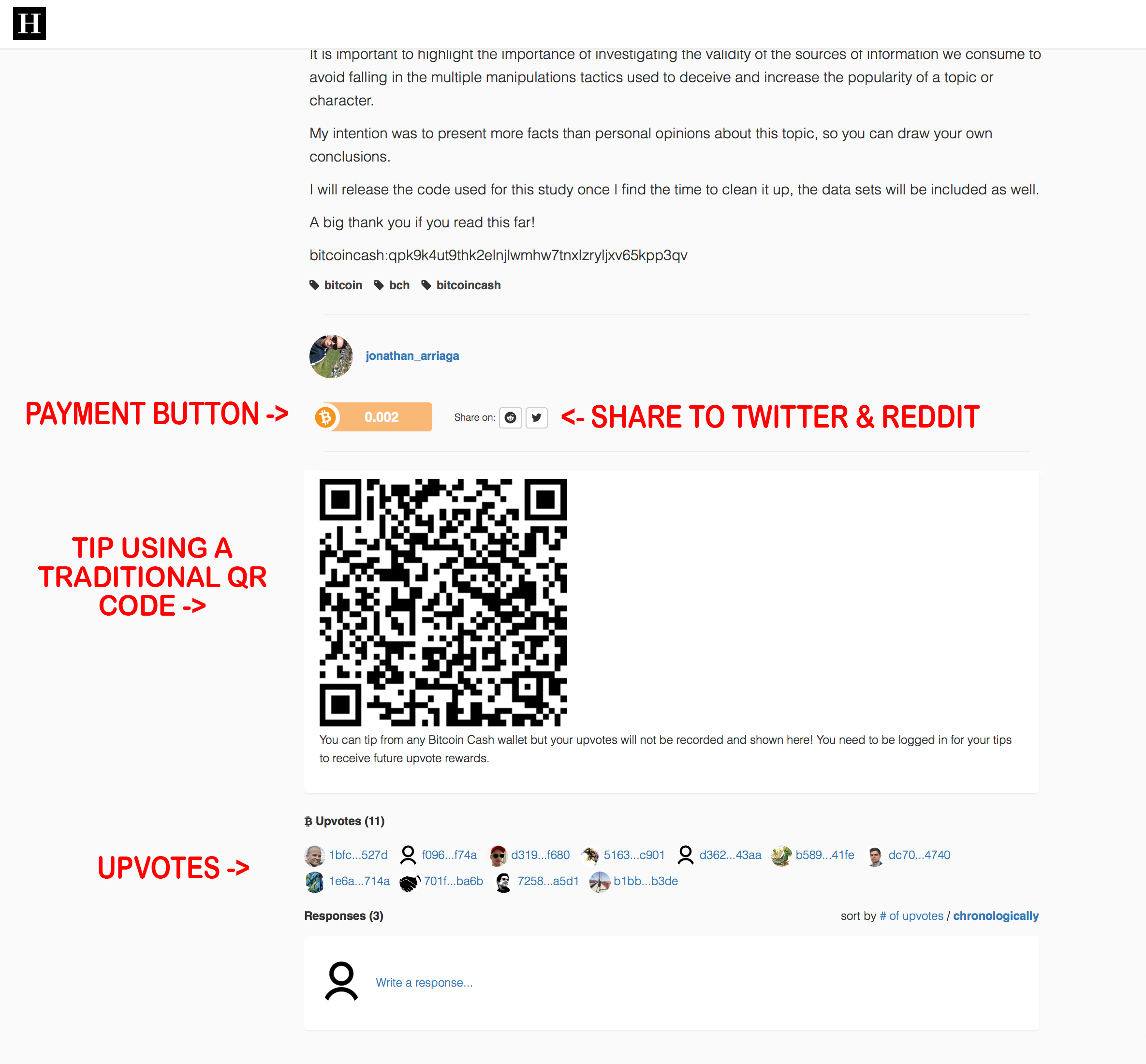
When Honest Cash first launched, the application was very simple with a tool that allowed for various formatting techniques. Since then the application has added the ability to upload photos, add tags and share using buttons tied to Reddit and Twitter. Moreover, posts have a payment button tied to them as well so visitors can tip in a matter of seconds. Honest Cash recently added a native wallet to the system and when a user signs up they are given a 12-word mnemonic seed phrase. There’s also a traditional QR code below the post so people can tip the author with other wallets. Upvoted transactions are also stored onchain so users can verify the traction of the post.
Honest Cash Publishing App Sees Organic Growth and New Features
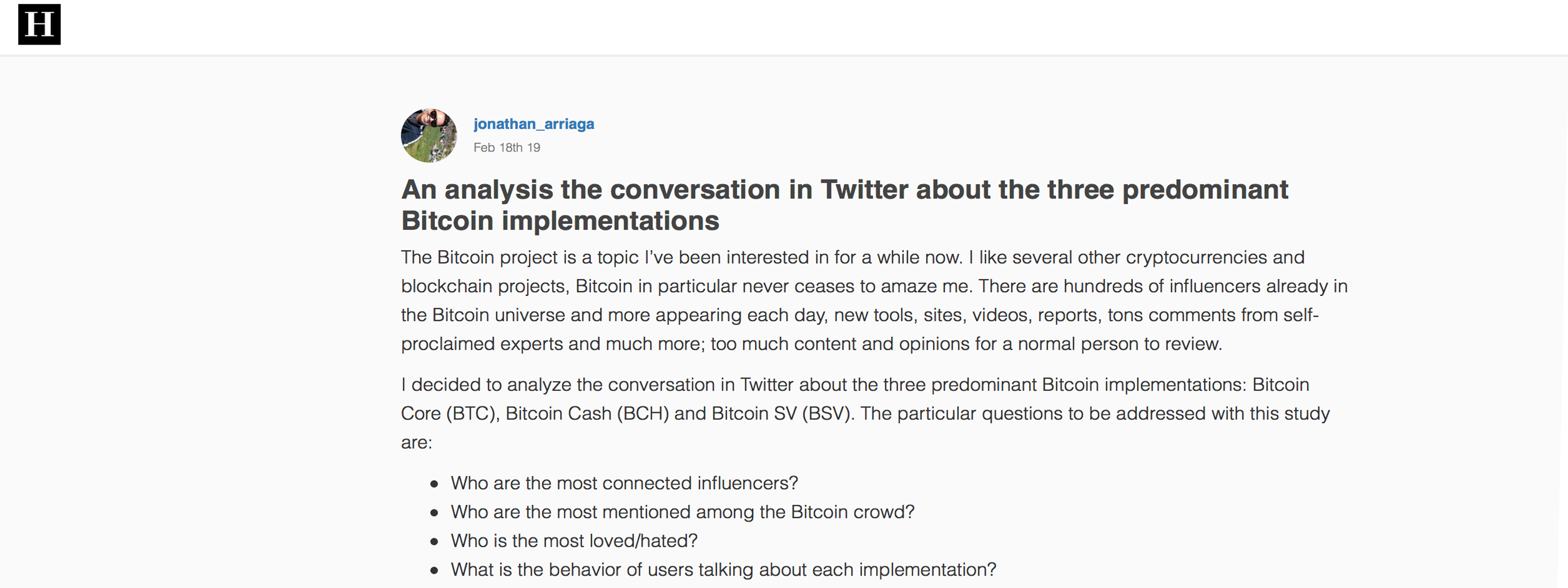
There are numerous Honest Cash posts about various subjects including art, hacking, cryptocurrencies, politics, traveling, and food. This was a popular post about an analysis of Twitter subjects being discussed between proponents of the three dominant Bitcoin implementations.

The Honest Cash Token and Badger Signups Soon

On Feb. 6, the Honest Cash founders revealed they were partnering with the Patreon alternative Bitbacker.io. The two teams hope the relationship will bolster a larger audience by providing users with the ability to “earn pledges and secure backing within both platforms.” During the second week of February, the Honest Cash team announced the distribution of a fraction of its Simple Ledger Protocol (SLP) coins called Honest Cash Tokens.
Honest Cash Publishing App Sees Organic Growth and New Features
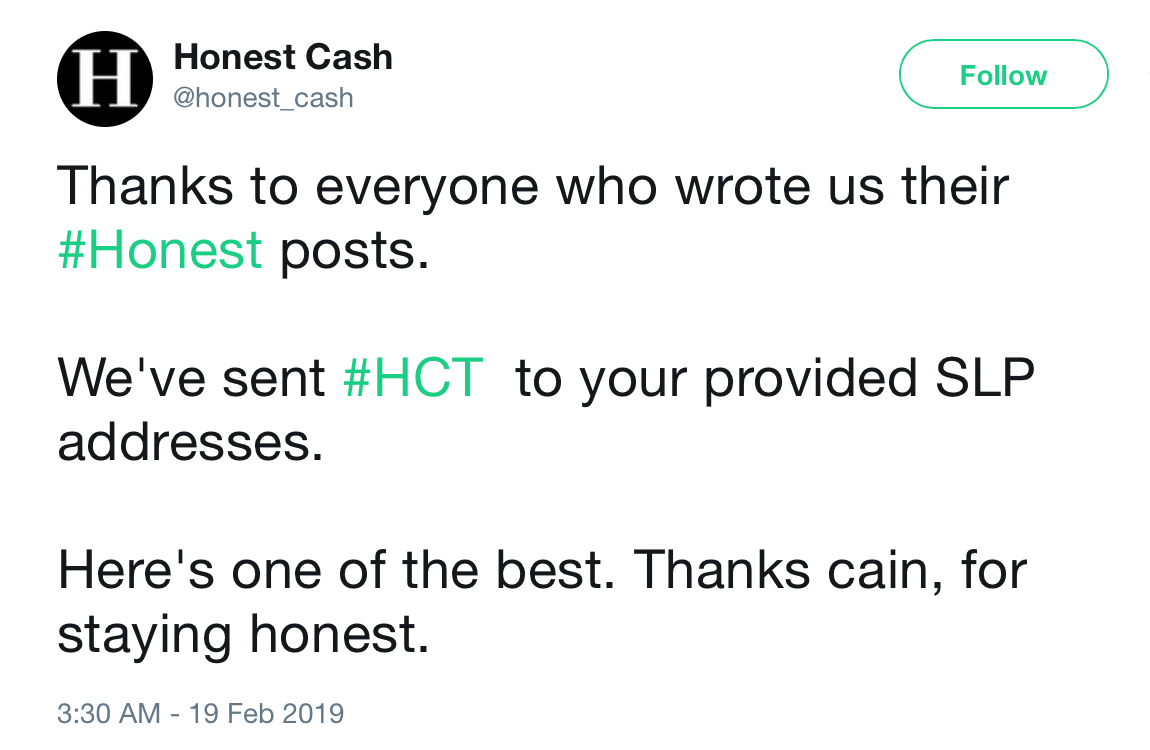
The team has been distributing HCT tokens to some of its Twitter followers and content creators on the platform. For instance, on Feb. 13, Honest Cash administrators announced a 1,000 HCT giveaway to users who write about advocating for an underdog. “Write a post on Honest.cash on any topic surrounding; honesty, censorship or discrimination,” explained the team.
Honest Cash Publishing App Sees Organic Growth and New Features
Posts offer a payment button, Twitter and Reddit share feature, upvoting onchain, and a traditional QR code.
Bitcoin cash users have been publishing material on the platform regularly and Honest Cash posts can be seen on the popular Reddit forum r/btc on a daily basis. The developers of Honest Cash seem to be integrating a system that lets users sign up with Badger Wallet or with a Twitter handle in the near future. Currently, signups are still by email only and registrants are allowed to create a password and write down their mnemonic phrase. From there, registrants are put on the Honest Cash waiting list until the next batch of users is approved.
What do you think about the Honest Cash blogging and publishing platform? Let us know what you think about this subject in the comments section below.


Saturday, April 14, 2018

Russian Court Bans Telegram, Founder Pavel Durov Defiant

Russian security services ordered Telegram to hand over access to encrypted user messages, but the messaging application (app) refused. Founder Pavel Durov didn’t bother to send lawyers to Moscow’s Tagansky court, and the court dutifully ruled against his company, taking less than 20 minutes in decreeing an immediate ban.

Russian Court Bans Telegram

Dmitri S. Peskov, Kremlin spokesperson, stressed, “There is a certain legislation that demands certain data to be passed to certain services of the Russian Federation.” Judge Yulia Smolina agreed, ruling, “The ban on access to information will be in force until the [Federal Security Service’s] demands are met on providing keys for decrypting user messages,” TASS reported.
Russian Court Bans Telegram, Pavel Durov Defiant
Roskomnadzor, a censuring media body responsible for attempting to ban everything from Github to pornography to white nationalist websites, evidently made the most vigorous appeal in urging the court to shutter Telegram. Last month, the company appealed before the Supreme Court over Russia’s Federal Security Service’s (FSB) 800,000 ruble fine. The FSB ordered Telegram to decrypt messages in accordance with relatively recent anti-terrorism laws. “We don’t do deals with marketers, data miners or government agencies. Since the day we launched in August 2013 we haven’t disclosed a single byte of our users’ private data to third parties,” a Telegram blog post insisted.
The only comment made at press time by Pavel Durov, regarding 13 April’s decision, came in a post to his personal Telegram channel, and it seemed every bit defiant as the 33 year old, “The power that local governments have over IT corporations is based on money. At any given moment, a government can crash their stocks by threatening to block revenue streams from its markets and thus force these companies to do strange things (remember how last year Apple moved Icloud servers to China). At Telegram, we have the luxury of not caring about revenue streams or ad sales. Privacy is not for sale, and human rights should not be compromised out of fear or greed.” Mr. Durov is a native Russian, but bailed in 2014 after his first enterprise, a social networking site called Vkontakte (VK), he claimed, was taken over by Putin in retaliation to Mr. Durov’s then-refusal to hand over user information as well.
Russian Court Bans Telegram, Pavel Durov Defiant
Pavel Durov

Legal Setback for a Company Thriving

Though Telegram has formal appeal rights, the court ruled with a sense of urgency, allowing the Roskomnadzor to take immediate action against the company. An irony not lost on officials is that they too use Telegram for communication purposes, and that includes President Putin’s own press office. Rumors are that it will move to Viber. 
Russian Court Bans Telegram, Pavel Durov Defiant
Telegram’s lawyer, Pavel Chikov, warned, “[Russia has] demonstrated again and again that the court system is devoted to serving the interests of the authorities. They no longer even care about basic external appearances.” Though both Facebook and Google have butted heads with Russian authorities, Telegram is only the second universal platform to be formally banned (Linkedin was the first).
Other than legal woes, the company has been on something of a growth spurt of late. It recently celebrated 200 million users, and is presently raising billions in what is being called the biggest initial coin offering so far.
Do you think Telegram will be impacted by the ban? Let us know in the comments section below.

Images courtesy of Shutterstock. 
Source : bitcoin.com

Wednesday, March 28, 2018

Mandela’s Golden Hands Sell for $10 Million in Bitcoin

A Canadian businessman agreed to sell four gold castings of South African leader Nelson Mandela’s hands. For $10 million in bitcoin, a cryptocurrency firm launching an initial coin offering (ICO) has agreed to the purchase, promising a world tour of the art pieces in an effort to educate more people about Madiba’s legacy.  

Mandela Art Sells for $10 Million in Bitcoin

South African-turned-Canadian businessman Malcolm Duncan has sold the four piece Nelson Mandela Golden Hands Collection, castings in gold of the South African leader’s hands. Canadian cryptocurrency company and aspiring exchange, Arbitrade, is delivering a total of 10 million USD in bitcoin for the prize. The marketing strategy is an interesting juxtaposition of history and the future, radical politics and radical free marketism, and Arbitrade’s curious business plan. The firm plans an upcoming ICO, mining operations, and a token supposedly backed by gold — thus the grandiose purchase.
Mr. Mandela was the first black president of South Africa, after a period of mandatory racial apartheid. He was charged in 1962 with violent insurrection against the government, and served nearly three decades in prison. President F.W. de Klerk released him in 1990, and the country has been on the long process of reconciliation and power sharing ever since. His advocacy of socialism might pose a philosophical problem for followers, considering go-go capitalism appears to have a piece of his legacy. He died in 2013 at the age of 95.   
Mandela’s Golden Hands Sell for $10 Million in Bitcoin
Mr. Duncan (Darren Makowichuk/Postmedia)
It has taken Mr. Duncan a decade to unload the hands (he reportedly purchased the sets for $31,000), two sets of two, casted in 99.999% gold, weighing a total of 20 pounds. For at ten years, it has been thought untoward to sell the pieces, which Mr. Mandela sat for in 2002 at the behest of a South African mining concern, Harmony Gold, to cast 27 sets, one for each year he spent a political prisoner. The sets are made up of a palm and a fist, but after two sets the project stalled, leaving commemoration of 1964 and 1990, years Mr. Mandela was jailed and freed from Pollsmoor, respectively.
Arbitrade insists it will world tour the collection, helping to educate more folks about Nelson Mandela, and, one would assume, cryptocurrency (at least their conception of it). An irony is the gold’s worth itself is rather little, but the symbolic art could be deemed by admirers as priceless, revealing another lesson: price discovery. 
Mandela’s Golden Hands Sell for $10 Million in Bitcoin
Mr. Mandela during molding (MARSTON-WEBB-INTERNATIONAL)

Art and Bitcoin, an Increasing Intersection

Len Schutzman, the company’s chairman, explained the recent purchase and subsequent publicity “was the first time the collection had been on display to the general public anywhere in the world since the Letter of Authenticity had been received from Harmony Gold, […] The collection celebrates not only the remarkable contributions of Nelson Mandela to humanity each year, but also all that has been done by South Africa in supporting gold and the mining industry through the years. Moreover, our timing in buying the collection is especially significant since we are celebrating the 100th anniversary of Mandela’s birth in this unique way for the first time in North America.”
Mandela’s Golden Hands Sell for $10 Million in Bitcoin
Darren-Makowichuk-Postmedia
For South Africans, art concerning Mr. Mandela is something of a controversy, as his image and name had been overused to such an extent he reportedly ordered all such art destroyed. Art purchased with bitcoin, however, has been steadily getting more attention. Last year, a painting by Mark Flood, Select a Victim, was auctioned through The White Company for $100,000 in the decentralized currency. Cork Street, the famed London gallery, accepts all manner of crypto in an effort to broaden customer base (the owner also is a booster of digital assets).
Mr. Duncan will release his collection fist by fist at 2.5 million USD per pop, in bitcoin. So far, he’s been paid about $50,000, with the remainder due sometime in April, according to reports. 
Is this a good marketing strategy for bitcoin? Let us know in the comments!

Images via Pixabay. 
Source : bitcoin.com

Tuesday, March 27, 2018

Russian, Chinese, Korean Associations to Sue Internet Giants Over Banned Crypto Ads

Cryptocurrency and blockchain associations from Russia, China and South Korea plan to file a class action against internet corporations banning crypto ads. The lawsuit will challenge restrictions imposed by Facebook, Google, Twitter and Yandex. An agreement to take the matter to court in the US has been reached at a crypto conference in Moscow.

Cartel Collusion and Abuse of Power

Russian, Chinese, Korean Associations to Sue Internet Giants over Banned Crypto AdsThe lawsuit will be filed in a US jurisdiction in May by the newly founded Eurasian Blockchain Association (EBA). Representatives of the Russian Cryptocurrency and Blockchain Association (RACIB), the Korea Venture Business Association (KOVA) and the Chinese Association of Cryptocurrency Investors (LBTC) have signed the agreement to create EBA during the BlockchainRF-2018 congress in Moscow (27-28 March). A special cryptofund will be created to finance the legal action, which can be supported through donations.

The most popular social network Facebook and the largest global search engine Google banned crypto ads in January and in March respectively. Russian media have reported about a similar decision by the biggest search engine in the country “Яндекс” (Yandex). The company has not official confirmed the measure.
Reports that Twitter is going to also impose restrictions surfaced about 10 days ago. According to Reuters, the microblogging platform has confirmed the policy change which will take effect on Tuesday March 27. The ban will cover advertising of initial coin offerings and token sales, Twitter told the agency this Monday. It has been reported that another social media platform, Snapchat, has also banned advertisements of ICOs.

Shareholders to Be Held Accountable

The simultaneous refusal to advertise cryptocurrencies could testify that there was a cartel collusion, said RACIB’s president Yuri Pripachkin, quoted by Tass and Interfax. “We think these four companies are using their monopoly power and have colluded to manipulate the market,” he added. Pripachkin pointed out that the bans led to significant market drops in the last months.
The matter will be taken to a US-based court, the official said. Lawyers will have the final say about the jurisdiction where the lawsuit will be filed. “You know, every state has different laws. Some states, like Wyoming for example, have been fair towards cryptocurrencies,” Yuri Pripachkin commented, quoted by RIA Novosti.
Pripachkin added that EBA can also sue the companies in the states where they are registered. Legal actions can be taken against their managers and shareholders, if it’s proved that they have and use cryptocurrency wallets, he said.

Russia Losing Money on ICOs Held Abroad

Russian, Chinese, Korean Associations to Sue Internet Giants over Banned Crypto AdsLast week RACIB warned that the Russian economy could lose up to 1.5 billion USD from ICOs conducted by Russians in more favorable jurisdictions. Coin offerings with Russian participation account for 10% of the global ICO market. Russian projects have attracted $310 million dollars in 2017, according to a report that will be presented to President Putin.

Two laws legalizing blockchain technologies, mining, cryptocurrencies and coin offerings have been introduced in the State Duma, the lower house of Russia’s parliament. They will be adopted in June or July this year, Anatoliy Aksakov, head of the parliamentary Financial Market Committee, said during the BlockchainRF-2018 congress.
Cryptocurrency miners will be obliged to register as individual entrepreneurs or legal entities under the new regulations, Aksakov told participants at the conference. He also revealed that mining businesses will enjoy tax breaks for a period of two years after the adoption of the digital economy legislation.
Do you think the US justice system will strike down the bans on crypto ads imposed by leading global internet corporations? Tell us in the comments section below.

Images courtesy of Shutterstock.
Source : bitcoin.com

Monday, March 26, 2018

Crypto Community Fears Passage of the CLOUD Act

The Clarifying Lawful Overseas Use of Data (CLOUD) Act just passed – almost in secret – tucked deep inside a voluminous spending package of well over a trillion dollars. No debate. No up or down vote on the merits of CLOUD. Instead, lawmakers would have had to reject the entire bill, thousands of pages, and risk government shutdown, in order to mount any kind of opposition. CLOUD is a broadening of international law enforcement power when it comes to online activity, and the crypto community is worried.

Hey! You! Get Off My CLOUD!

Senator Orrin Hatch, President Pro Tempore of the US Senate, explained, “The CLOUD Act bridges the divide that sometimes exists between law enforcement and the tech sector by giving law enforcement the tools it needs to access data throughout the world while at the same time creating a commonsense framework to encourage international cooperation to resolve conflicts of law.”
It hasn’t been a great couple of weeks for cryptocurrency privacy advocates. Revelations from notorious whistleblower Edward Snowdenshowed a long, consistent pattern of US government eavesdropping and tracking of bitcoiners in particular since at least 2013. Now, new US legislation smuggled into an2 omnibus spending bill appears to give government ever-more power in its ability to monitor online privacy.
Crypto Community Fears Passage of CLOUD Act
Sen. Rand Paul proved the only lawmaker to attempt reading all 2,232 pages.
On page 2,201 of a 2,232 page document finds S. 2383/H.R. 4943 Clarifying Lawful Overseas Use of Data portion, commonly referred to as the CLOUD Act. It’s the combined brainchild of legal minds at Apple, Facebook, Microsoft, Google, Yahoo! and Senator Orrin Hatch, 84, who has held his seat since 1977 (Star Wars opened, Jimmy Carter was president, and Atari 2600 was released).
A joint statement from all five companies reads, “The new Clarifying Lawful Overseas Use of Data (CLOUD) Act reflects a growing consensus in favor of protecting Internet users around the world and provides a logical solution for governing cross-border access to data. Introduction of this bipartisan legislation is an important step toward enhancing and protecting individual privacy rights, reducing international conflicts of law and keeping us all safer.”

EFF and ACLU See Further Intrusions and Worse

Companies such as Microsoft have been involved in privacy battles, and one of them has reached the US Supreme Court this year. The Court is mulling over whether Microsoft must give the Department of Justice (DOJ) data stored in Ireland. The case has been ongoing since 2013. It’s probably the case major tech companies want a uniform set of rules governing international compliance laws instead of litigating at every turn. Evidently these platforms feel the CLOUD Act is an optimum compromise between protecting privacy and necessary law enforcement access.
The Electronic Frontier Foundation (EFF), however, is having exactly none of it. Referring to the legislation as A New Backdoor Around the Fourth Amendment, the EFF stresses the CLOUD Act fails “to require foreign law enforcement to seek individualized and prior judicial review. Grants real-time access and interception to foreign law enforcement without requiring the heightened warrant standards that U.S. police have to adhere to under the Wiretap Act. Fails to place adequate limits on the category and severity of crimes for this type of agreement. Fails to require notice on any level – to the person targeted, to the country where the person resides, and to the country where the data is stored.”
Crypto Community Fears Passage of CLOUD Act
American Civil Liberties Union (ACLU) released its own warning regarding CLOUD in conjunction with two dozen privacy-oriented organizations. Among “other things, the legislation would: Allow foreign governments to wiretap on U.S. soil under standards that do not comply with U.S. law; Give the executive branch the power to enter into foreign agreements without Congressional approval; Possibly facilitate foreign government access to information that is used to commit human rights abuses, like torture; and Allow foreign governments to obtain information that could pertain to individuals in the U.S. without meeting constitutional standards.”
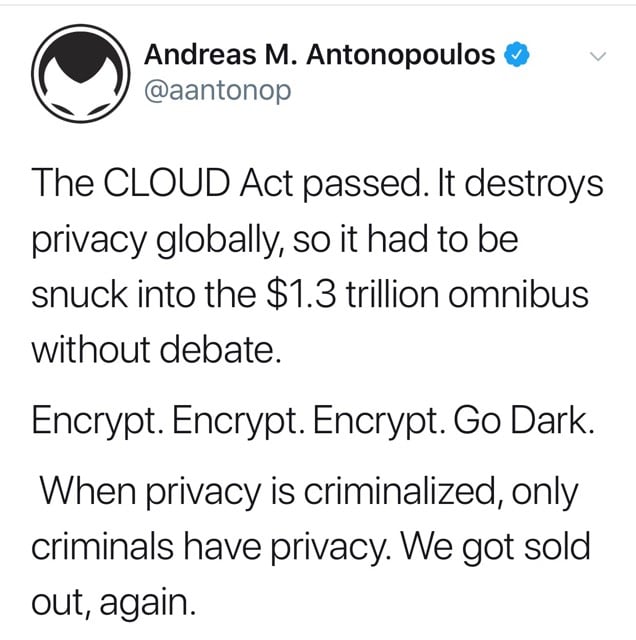
Well-respected cryptocurrency luminary Andreas Antonopoulos urged, ““The CLOUD Act passed. It destroys privacy globally, so it had to be snuck into the $1.3 trillion omnibus without debate. Encrypt. Encrypt. Encrypt. Go Dark. When privacy is criminalized, only criminals have privacy. We got sold out, again.” Indeed, cryptography by definition is a privacy oriented pursuit. And so undoubtedly the quest for better privacy coins and encryption methods will continue with at least a little more urgency.  
Does legislation like CLOUD worry you? Let us know in the comments!

Images via Pixabay, Twitter. 
Source : bitcoin.com

Saturday, March 24, 2018

Bitcoin Ransomware Attack Halts Major American City’s Government and Police

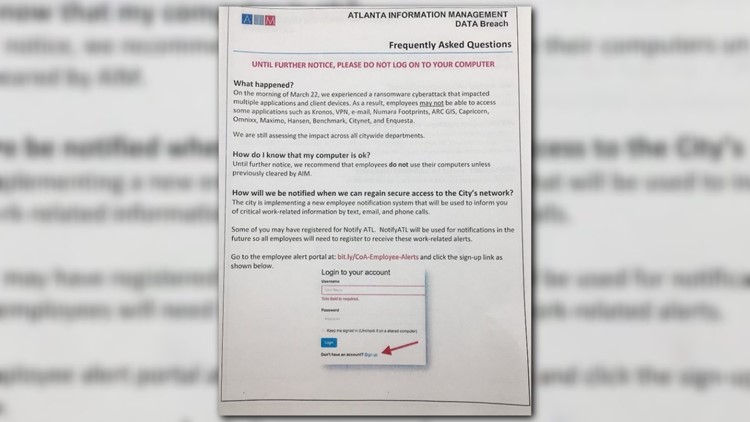
Many government services in Atlanta, Georgia, a major metropolitan US city, were brought to a halt this week. Ransomware appeared on municipal computers, urging a payment of $51,000 in equivalent bitcoin, otherwise vital city functions would be shut down. The hackers made good on their threat, and services all over the city were impacted, including police. Into the weekend, the issue has not yet been resolved.

Atlanta Ransomware Attackers Demand Bitcoin

National Broadcast Corporation (NBC) television Atlanta, Georgia affiliate, 11 Alive, broke the story early Thursday morning: The city of Atlanta’s computers are being held hostage. The anchors announced police departments, courts, and just about every single department was impacted by the ongoing cyber attack. The attacker(s) demanded the curious sum of $51,000 in the equivalent of bitcoin as ransom.
At 5:30am city employees received an official email about an issue critical enough to order computers powered down and unplugged from the wall. At roughly the same time, employees were also seeing a demand for bitcoin on their screens. To be able to get back into their systems, they’d have to pay. Initially the city claimed it to be a computer outage, but leaks from various departments told another story to local media. All indications pointed to what’s known as a ransomware attack.
Bitcoin Ransomware Attack Halts Major American City’s Government
It’s not the first for a US city: Sarasota, Florida (a demand for 33 million USD was avoided by an alert worker who yanked cords from the wall); Leeds, Alabama (which paid upwards of $12,000 to get back into their computers); Hinesville, Georgia; Farmington, New Mexico (still do not have access to their computers); Englewood, Colorado (shut down the entire city’s computer infrastructure).  
Federal Bureau of Investigations (FBI) and Department of Homeland Security (DHS) teams have taken up the case. The seriousness of the situation is evidenced by a rumor the city would shut down government offices the following business day if need be. Perhaps the most maddening aspect of the whole affair was not knowing the extent of the compromise. The city’s famous international airport, evidently, wasn’t impacted. Police, however, were sent back two decades technologically, resorting to writing reports and filing them by hand (it seems this effort was taken out of caution rather than due to the hack).

Still Nothing Definitive

By mid-afternoon, city water customers were not allowed to pay water bills online, and so local government asked users to be particularly proactive in case personal data was stolen. City workers openly worried about timesheets and pay, which is all done via computer. Officials assured everyone would be paid, even if physical checks must be cut. “We don’t know the extent of the attack,” announced mayor Keisha Lance Bottoms. She urged patience, “We want to make sure we don’t put a Band-Aid on a gaping wound. We don’t know the extent or if anyone’s personal data or bank accounts will be compromised. All of us are subject to this attack.”
Bitcoin Ransomware Attack Halts Major American City’s GovernmentAnd while there is never a good time to have such an attack, it does come at a particularly touchy moment for Atlanta. It’s said to be on the short list for an Amazon facility, it’s set to host March Madness basketball events, and a giant gun control rally was scheduled for Saturday.
Despite multiple requests, the mayor has refused to answer whether the city will pay the bitcoin ransom.  
Should the city pay a ransom? Let us know in the comments!

Images via Pixabay, Twitter, NBC. 
Source : bitcoin.com

Friday, March 23, 2018

Japan Exchange Bitarg Denies Yahoo Acquisition Press Reports

Media outlets are touting what would amount to a major shake-up of cryptocurrency exchanges, Bitarg Exchange selling off a little less than half its business to Yahoo Japan. Reports even detailed how Yahoo Japan (YJFX) would then launch still another exchange built on Bitarg’s system by spring of next year. As of March 23, Bitarg is vigorously denying press accounts, insisting they were instead “studying various possibilities.”

Also read: Bitcoiners Demand More Crypto CFDs and Spread-Betting in the UK

Bitarg Denies Yahoo Japan Rumors

A Bitarg statement with the salutation 株式会社ビットアルゴ取引所東京 代表取締役 尹 煕元, google translated as, “Bit-Argo Exchange Co., Ltd. Tokyo Representative Director Yoon Hee Yuan,” came after rumors of a done deal surfaced between the exchange and Yahoo Japan, according to an unsigned Nikkei Asian Review article.
The Nikkei headline and subtitle read, “Yahoo Japan to open cryptocurrency exchange; First step to be taken next month — tie-up with Bitarg Exchange Tokyo.” The online post insists, “The two companies have reported their capital tie-up plan to the FSA [(Financial Services Agency)].”
Japan Exchange Bitarg Denies Yahoo Acquisition
It goes on to detail how “Yahoo Japan next month will acquire 40% of operator Bitarg Exchange Tokyo, then launch a full-blown exchange in April 2019 or later. The Yahoo Japan exchange will be newly built but based on Bitarg’s system. Yahoo Japan will make additional investments in Bitarg, which is registered with the Financial Services Agency, early in 2019,” calling such moves “a realignment in the cryptocurrency exchange business.”

A Tantalizing Head Scratcher

For its part, Bitarg called out the Nikkei post in particular, as it “reported that our company accepted the investment from Weijay FX Corporation (100% subsidiary of Yahoo Japan Corporation) and will make a capital alliance, but this case it is not what we announced. Based on the recent environmental changes surrounding the virtual currency industry, we are studying various possibilities, including capital and business tie-ups with other companies, in order to further strengthen the system and management, […],” google translate clunkily phrased. “There is nothing we did. We will respond promptly when deciding the facts to be announced in the future,” Ms. Yuan urged.
Japan Exchange Bitarg Denies Yahoo Acquisition
Still, the article is a tantalizing read, filled with specifics, including how the purchase of Bitarg shares “will be made through Tokyo’s YJFX, a wholly owned Yahoo subsidiary that operates foreign exchange transaction services,” and “YJFX will pay about 2 billion yen ($19 million) for a 40% stake in Bitarg. The stake will be made up of outstanding shares and newly issued stock.”
The report also noted more investments will be made through yet another YJFX subsidiary during early next year, and that as soon as April of this year Yahoo Japan big wigs will spend “about a year” at Bitarg working on the new exchange configuration, internal controls, customer management, and corporate governance, … leaving outside observers scratching their heads.
Do you think they’ll merge? Let us know in the comments!

Images via Pixabay, Bitarg. 
Source : bitcoin.com

20% of University Students Use Financial Aid to Buy Cryptocurrency

During March 16th through till March 20th of this year, The Student Loan Report teamed with Pollfish to survey 1,000 current university students with related loan debt, asking one question: Have you ever used student loan money to invest in cryptocurrencies like Bitcoin? The results surprised even the pollster.

University Students Buy Crypto with Financial Aid

Founder of the Student Loan Report, Drew Cloud, explained, “Younger Americans are certainly the most enthusiastic about cryptocurrency; they are the most active investors and want to get involved in the space in any way possible. However, I truly thought the percentage would be lower. As a college student, your budget is thin and that extra money could be used on rent, groceries, or books,” he told the Boston Globe.
The survey “found that 21.2 percent of current college students with student loan debt have used financial aid money to fund a cryptocurrency investment,” the study found. Over four days students with debt were asked one question about buying cryptocurrency with loan money, and over one-fifth responded in the affirmative.

The Student Loan Report asserted, “Student loan borrowers would be able to pull off such a maneuver because they are given their remaining student loan funds to be used on ‘living expenses.’ Sometimes, student debtors borrow more than they end up needing for that semester of classes. Once the borrower’s college or university’s financial aid office uses the necessary financial aid to pay for courses, they send a refund check to the borrower.”
College borrowers’ spending of the money isn’t tracked officially, allowing whatever is leftover to be spent in the manner preferred by the debtor. Another contributing factor is student loan debt payments usually do not occur until after graduation, and typically six months after.

Savvy or Stupid?

“Cryptocurrency was the hottest investment of 2017,” Mr. Cloud detailed, “especially for young Americans, so it is easy to understand why many college borrowers would think it was a savvy way to spend their refund checks. Some might have even figured that they would be able to quickly pay off their student debt because not long ago every single virtual currency was experiencing seemingly unstoppable growth.”
20% of University Students Use Financial Aid to Buy Cryptocurrency
Noticeably missing from the survey are data regarding how much the average university student spent of their financial aid on cryptocurrency. It also would’ve been interesting to find out which cryptocurrency students favored.
“Could they have used spent, or even saved, this money more prudently?,” Mr. Cloud mused. “Absolutely. ​A perfect example would be stowing that money away in a high-yield savings account that they could later use to chip away at their student debt. But there is always the chance that there is another period of explosive growth for virtual currency, and these borrowers will be laughing all the way to the bank. Or, they could just as easily lose all of that financial aid money that they just invested in Bitcoin.”
What do think about using loans to buy crypto? Let us know in the comments!

Images via Pixabay, Student Loan Report, Pollfish. 
Source : bitcoin.com