Showing posts with label News. Show all posts

Monday, March 4, 2019

Venezuelan Government Launches Crypto Remittance Service


The government of Venezuela has begun offering a cryptocurrency remittance service. Remittances can be sent using two types of cryptocurrency. The service was launched by the Superintendency of Cryptoassets and Related Activities, the country’s main crypto regulator, which has also set a monthly limit and a commission per transaction.

Government’s Remittance Service

The government of Nicolas Maduro has started offering a cryptocurrency remittance service. The Superintendency of Cryptoassets and Related Activities (Sunacrip), the main regulator of all crypto activities in Venezuela, announced the launch of the service on its Patria platform last week. According to its website:
The cryptocurrencies that can be used to send [remittances] are bitcoin and litecoin.
Once the cryptocurrency transaction is confirmed, the funds will be available on the platform in sovereign bolivars, Venezuela TV reported, noting that “The system will allow the user to receive a maximum of cryptocurrency equivalent to 10 petros per month [in bolivars].” However, with specific approval by Sunacrip, the recipient can receive up to “the equivalent in euros of fifty (50) petros.”
The petro is Venezuela’s national digital currency which the Maduro government claims to be a cryptocurrency backed by oil, gold, diamond, and other natural resources. Each coin was previously worth 3,600 sovereign bolivars (Bs.s). However, President Maduro raised its rate to 9,000 Bs.s in December and againin January to 36,000 Bs.s.
Venezuelan Government Launches Cryptocurrency Remittance Service
Photo credit: @Joselitramirez

Using the Patria Portal

The terms and conditions page of the Venezuelan government’s remittance website states that “To be a recipient of crypto remittances, the natural person must be registered with the Patria platform, be of legal age and reside in the Bolivarian Republic of Venezuela.” Senders, however, can be outside of Venezuela.
To use the platform, the sender must enter an email address to which a code will be sent in order to log in. “The code sent is a one-time password … a new one will be sent each time that it is required to access the remittance system,” the Patria website details. Upon entering the system, the sender will be prompted to enter their first and last name, date of birth and country of residence. The sender will then be asked to enter the national identification number and date of birth of the recipient.
Venezuelan Government Launches Cryptocurrency Remittance Service
The next step is to select the cryptocurrency and the amount of remittance to send. At this point, the sender “will see the reference exchange rates at the time of the transaction and the type of cryptocurrencies: bitcoin and litecoin,” Agencia Venezolana de Noticias (AVN) elaborated.

Exchange Rates

The exchange rate of the cryptocurrency sent “will depend on the date and time of the transfer” which will be determined based on its value in euros shown on the Patria website, Venezuela TV described. Its value in bolivars will be determined based on the official rate published by the Central Bank of Venezuela (BCV).
Venezuelan Government Launches Cryptocurrency Remittance Service
Emphasizing that the recipient will receive the amount of the cryptocurrency sent based on its rate “in euros and the official exchange rate of the euro in bolivars,” the publication added:
The value of the remittance will be deducted by a commission, calculated and shown on the platform, up to a maximum of 15%.
“The minimum commission amount will be the equivalent of 0.25 euros [~$0.28] in bolivars for each transaction,” Patria’s website states, adding that the exchange rate of the cryptocurrencies “will be adjusted every ten (10) minutes or when required and will be published on the website of the platform.”
What do you think of the Venezuelan government starting its own crypto remittance service? Let us know in the comments section below.
Disclaimer: Bitcoin.com does not endorse or support claims made by any parties in this article. None of the information in this article is intended as investment advice, as an offer or solicitation of an offer to buy or sell, or as a recommendation, endorsement, or sponsorship of any products, services, or companies. Neither Bitcoin.com nor the author is responsible, directly or indirectly, for any damage or loss caused or alleged to be caused by or in connection with the use of or reliance on any content, goods or services mentioned in this article.


Tags :
#Crypto in Venezuelan
#Bitcoin in Venezuelan
#Remittance Service in Venezuelan

Wednesday, February 27, 2019

Cryptocurrency Jobs Peak in These Indian Cities


Demand for skilled professionals in the crypto space has been steadily rising, according to new data that ranks cities in India based on the number of jobs in the cryptocurrency field. Some cities such as Mumbai dropped several places from last year’s ranking while a couple of others are new to the list.

Hottest Cities for Crypto Jobs

According to new data from job listing site Indeed, Bengaluru is the number one city in India for crypto jobs, followed by Pune, the second largest city in the Indian state of Maharashtra. Mumbai dropped from the second hottest place for crypto jobs last year to the seventh place this year. Money Control elaborated:
Bengaluru maintained the lead as the city with the most jobs in the cryptocurrency field … Pune is followed by Hyderabad, Noida and Gurgaon, making up the top five destinations for crypto-careers in India.
Two cities which were not on the previous list made the top ten list this year: Ahmedabad and Thiruvananthapuram. “While northern markets see consistent demand, the numbers still do not compare to their southern counterparts,” the news outlet noted. Bengaluru is home to Unocoin, a major cryptocurrency exchange in India.
Cryptocurrency Jobs Peak in These Indian Cities
“Given the enormous scope of blockchain technology, crypto careers offer newer avenues to explore, provided one has the requisite skills,” explained the director of Indeed India, Venkata Machavarapu. “Demand for such skilled professionals has been steadily on the rise, as observed in 2018, with technology hubs such as Bengaluru and Hyderabad continuing to create the maximum number of opportunities.”

Uncertain Crypto Regulatory Environment

The Indian government is actively working on cryptocurrency regulation. The country’s supreme court on Monday gave the government four weeks to come up with a clear legal framework for cryptocurrencies. The court will then hear the petitions against the crypto banking ban by the central bank, the Reserve Bank of India (RBI), as well as other crypto-related petitions.
Cryptocurrency Jobs Peak in These Indian Cities
The central bank issued a circular in April last year, banning all financial institutions under its control from providing services to crypto businesses, effective three months later. Since then, a number of crypto businesses have been hampered. Zebpay, formerly one of the largest crypto exchanges in the country, had to close down its local crypto exchange activities due to the banking restriction. Other exchanges have come up with creative solutions such as offering exchange-escrowed peer-to-peer (P2P) services.
The government committee headed by Subhash Chandra Garg, Secretary of Economic Affairs, is in charge of drafting the regulation. Recommendations are reportedly being finalized. In January, the Ministry of Finance invited law firm Nishith Desai Associates to present their suggestions for the crypto regulation. Last week, Indian policymakers gathered at a blockchain summit and agreed on the importance of establishing a legal framework for cryptocurrencies.
What do you think of these top cities for crypto jobs in India? Let us know in the comments section below.

Thursday, March 22, 2018

Chinese Exchange Bitasia Now Supports 0-Confirmation BCH Transactions

Earlier this week the Chinese exchange Bitasia announced it started accepting zero-confirmation transactions for bitcoin cash (BCH) for instant trading. The trading platform is one of the first exchanges to enable zero-confirmation transactions so traders can use the platform as quickly as possible.

Chinese Exchange Bitasia Adds Zero-Confirmation Support for BCH Deposits

Chinese Exchange Bitasia Supports 0-Confirmation BCH TransactionsThe Chinese exchange Bitasia is a trading platform that allows traders to swap a variety of cryptocurrencies including ETH, LTC, ETC, BTC, BCH, and more. This week the exchange detailed that after some contemplation the trading platform will support zero-confirmation transactions for the bitcoin cash network. A zero-confirmation transaction means that exchanges, merchants, and other businesses are willing to accept a digital currency before the first network confirmation. The general sentiment within the BTC community is that at least one confirmation is needed to prevent double spends.
However, a while ago the developers Gavin Andresen and Tom Harding created specific patches that prevents fraud from happening when zero-confirmation transactions take place. However, the bitcoin core (BTC) developers have removed those patches from the core codebase. Now bitcoin cash developers and the community, in general, believe that zero-confirmation transactions are completely safe and have started testing zero-confirms on the main network over the past few weeks.

Other BCH Businesses Testing and Challenging Zero-Confirm Skeptics

For instance, the Mini-POS device developers have implemented zero-confirmation transactions. Another example is the company Cryptonize.it who offered a challenge to someone who was willing to try a double spend on a $1,000 transaction. A person tried to double spend the BCH but failed and lost $2,000 trying to exploit the transaction.

The First Exchange to Implement Zero-Confirm Support

Now Bitasia is one of the first cryptocurrency trading platforms to add zero-confirmation support to the exchange.
“After careful consideration, Bitasia will support the BCH zero confirmation (0-confirmation) arrival and instant trading,” explains the Chinese exchange.
Bitasia focuses on security and value user experience — For other currencies that use the Segwit mechanism, our current policy remains unchanged and the Segwit plan has not been launched.
Chinese Exchange Bitasia Supports 0-Confirmation BCH Transactions
Bitcoin cash supporters were thrilled to hear about Bitasia supporting zero-confirmation BCH transactions. However, a new website called “Doublespend.cash,” has recently published a list of all the double spends attempts against zero-confirmation BCH transactions. Bitcoin cash supporters are very skeptical of that website’s data as most of the transactions have a fee set lower than the network relay minimum requirement. The reason for this is because transactions under 1 satoshi per byte are typically never propagated throughout the BCH clients. Due to this reasoning, most BCH proponents see the Doublespend.cash website as an attempt to spread FUD (fear, uncertainty, and doubt).
What do you think about Bitasia adding zero-confirmation support for BCH traders? Let us know in the comments below.

Images via Shutterstock, and Bitasia.
Source : bitcoin.com

Crypto Collectibles Are Worthless Without a Website

Crypto collectibles are big business right now. Crypto Kitties just raised $12.5 million in venture capital, and lookalike sites are springing up everywhere trying to cash in on the craze for non-fungible digital assets. For all their innovation, these ‘decentralized’ projects have an achilles heel: without a website, the digital assets are worthless, as the collapse of Crypto Celebs and similar platforms shows.

ERC271 Tokens Are Valuable Until They’re Not

ERC271 is the non-fungible token (NFT) standard used to fuel most of the digital collectible projects currently in the news. They’ve been described as “the next boom” for ethereum after ERC20 tokens, which drove the ICO craze. The ability to claim sole ownership of a digital asset, and to retain it on a wallet you hold the keys for, is pretty cool. But all you really own is a number assigned to your address by a smart contract. The associated element – the thing that gives the NFT its value – relies on a centralized server to host the image, just like the images displayed on this page.
Crypto Collectibles Are Worthless Without a Website
If the blockchain is a football field, the website is the ball. Take away the ball and no one can play. That’s what happened with Crypto Celebrities, a short-lived ethereum trading card game that relied on the “greater fool theory” to bump up the price of the celebs whose pictures were assigned to each ERC271. Crypto All Stars – the same idea applied to Twitter cryptocurrency traders – also died a quick death. The demise of these sites exposes one of the inherent drawbacks to NFTs. If you buy ethereum from a broker such as Coinbase and they later go out of business, your ETH is still worth something. If the same were to happen with Crypto Kitties, all those adorable little cats would effectively cease to exist.

Blockchains Don’t Add Value – People Do

The reason why cryptocurrencies attain value isn’t because they’re on a blockchain: it’s because enough people are willing to accept them as a medium of exchange. Only then do they gain value. People might be willing to play several ETH for an especially cute or rare collectible, but take away the image – i.e the part that adds value – and all that’s left is a unique token nobody wants. In defense of non-fungible tokens, they’re a promising field whose use cases are still being felt out.
Crypto Collectibles Are Worthless Without a Website
Decentraland
Ethmoji allows people to create their own avatar out of composite parts, with creators being paid by smart contract for each piece that’s used such as a face or a hat. Then there’s Decentraland, a virtual world whose land marketplace opened last week. Venture capitalist Barry Silbert has called Decentraland the killer app for VR. Each plot of land can be traded as an NFT, and single squares are changing hands for hundreds or even thousands of dollars. There’s no reason to suspect that Crypto Kitties or Decentraland will be going anywhere. But due to the centralized design of these systems, their ecosystem is reliant upon a single point of failure. If it goes down, the value of even the rarest NFTs becomes zero.
What are your thoughts on projects that involve digital scarcity such as Decentraland? Let us know in the comments section below.

Images courtesy of Shutterstock, Ethmoji, and Crypto Kitties.
Source : bitcoin.com

University Student Gang ”Breaking Bad” Jailed For Dealing $1M+ in Drugs for Bitcoin

The fall of the Silk Road marketplace continues to vertebrate around the world, this week leading to a number of university students going to jail for many years. The young men have been found guilty of selling party drugs and tranquilizers online for bitcoin. 

Breaking Bad Gang

University Student Gang ”Breaking Bad” Jailed For Dealing $1M+ in Drugs for BitcoinA group of University of Manchester students, nicknamed the ‘Breaking Bad Gang’ by the British press, have been convicted of dealing drugs on the dark web market Silk Road for bitcoin. On Wednesday they were sentenced to long prison terms by the Manchester Crown Court.

The group has been found guilty of trafficking illicit drugs to clients all over the world, including Europe, America, Australia and New Zealand, as well as in their home town of Manchester. The UK authorities have reportedly been alerted to their operations after the Silk Road marketplace was taken over by US investigators.
The so-called university gang included pharmacology, computer science, petrochemical engineering, geology and marketing students. They were found to be selling ecstasy, LSD, 2C-B and ketamine, worth over a million dollars in total from May 2011 to October 2013. UK National Crime Agency officers who raided their apartment said they discovered “what can only be described as a drug dealing factory”. According to the local press reports they also didn’t hide their wealth very well and used some of the proceeds for holidays in Jamaica, the Bahamas and Amsterdam.

One-Stop Shop

University Students Jailed For Dealing Over $1 Million in Drugs for BitcoinJoshua Morgan, 28, has been sentenced for seven years and two months. James Roden, 25, has been sentenced to twelve years. Jaikishen Patel, 26, has been sentenced for eleven years and two months. Elliott Hyams, 26, has been sentenced for eleven years and three months. Basil Assaf, 26, has been has been sentenced for fifteen years and three months.

According to reports from the court, Circuit Judge Michael Leeming told the young men: “To all intents and purposes, you operated a one-stop shop, cutting out the middle man. The use of the dark web is an aggravating feature, not a mitigating one. That should be made clear. You all knew the score and the scale of what was going on. As intelligent young men you will all each appreciate that that misery is caused and certainly contributed to by people like you.”
A similar case was recently uncovered on the other side of the pond, where Navy investigators have busted an alleged drug ring at the U.S. Naval Academy.
Why are there so many bitcoin-related drug cases coming to light recently? Share your thoughts in the comments section below!

Images courtesy of Shutterstock.
Source : bitcoin.com

Sunday, March 18, 2018

Secretive High-Tech Wall Street Trading Firm is Now Trading Bitcoin

This week Jane Street Capital a global proprietary trading firm has announced it has been trading BTC these days. Often referred to as one of Wall Street’s most secretive investment companies, Jane Street says if cryptocurrencies continue to rise they expect to be involved.

The ‘Secretive’ and High-Tech Trading Firm Jane Street is Flipping Bitcoins

This High-Tech Wall Street Trading Firm is Now Trading BitcoinThe trading firm Jane Street operated in New York City, London and Hong Kong and the company actively trades $8-13 billion worth of equities, Bonds, Futures, Options, and other investments. Jane Street claims to execute over 1Mn trades per day. The New York Times has referred to Jane Street as one of the most secretive firms out there that handles a lot of trade volume. The news outlet called the traders “coders with a Ph.D.” and the firm specializes in lots of arbitrage trades. According to Business Insider, the firm has explained it is now dabbling in BTC trading.
Arbitrage opportunities in the world of cryptocurrencies and bitcoin are very tempting to firms like Jane Street because spreads can be very high on different trading platforms. Global BTC exchanges can have as much as 10 percent in arbitrage opportunities between each trading venue. Jane Street has not given any details on how it has been trading BTC but explains that if cryptos continue to be hot, the company will continue to remain active.
“Jane Street trades over 56,000 products globally across a wide variety of asset classes, including bitcoin,” the company explains this week.  
Jane Street has always taken a considered approach to trading opportunities and will continue to do so, as more cryptocurrency products emerge, we expect to be involved.
High-Tech Wall Street Trading Firm Jane Street is Trading Bitcoin
Cryptocurrency arbitrage opportunities can be as much as 10% on different exchanges.

Jane Street Follows Other Well Known Wall Street Market Makers

The news also follows other big-name Wall Street firms who have been reportedly trading bitcoin or crypto-based exchange-traded notes and futures products. This year at the World Economic Forum in Davos, Goldman Sachs Lloyd Blankfein explained if clients want to trade BTC they will help facilitate. “We’re clearing futures in bitcoins for some of our futures clients — We’d clear them,” explains Blankfein. “We’re a prime broker, and so if our clients are going to do it, we’re going to do it.”
Back in September of 2017, Jamie Dimon explained that bitcoin traders were “stupid.” But the firm was caught red-handed trading BTC exchange-traded notes for clients. Further, the company has stated it is open to offering clients CME and Cboe bitcoin futures.
Jane Street is different than JP Morgan and Goldman as it uses the Ocaml programming language that helps the firm’s traders quickly execute trades in changing market conditions. The company has even released some open source code for its Ocaml libraries. Jane Street did not reveal to the press how it was actively trading cryptocurrencies.
What do you think of Jane Street trading bitcoin? Let us know what you think about this story in the comments below. 

Images via Shutterstock, Pixabay, and Jane Street. 
Source : bitcoin.com

Monero Miners In Uproar After Panic Algorithm Change Due to ASICs Coming Online

Bitmain has found itself in a war with words with the monero community over the release of its latest cryptocurrency miner, the Cryptonight-capable X3. The unit is being offered at a discounted rate to existing customers, but critics claim this is because the miners will soon be ineffective at mining monero, the main coin to use the X3’s Cryptonight technology. Monero lead developer Riccardo Spagni has emphasized that the units will not work on monero due to a scheduled hard fork designed specifically to outwit the Cryptonight algorithm.

Monero’s Crypto Nightmare

“We are pleased to announce the all-new Antminer X3, to mine cryptocurrencies based on the Cryptonight hashing algorithm,” tweeted Bitmain cheerily on March 15. The new units would start shipping instantly, limited to one per customer to prevent hoarding. The price would even be dropped to $3,000 for existing customers, according to an email. Posters on monero’s reddit board have urged buyers not to purchase the units due to the scheduled change to the coin’s Proof of Work algorithm. Others have gone so far as to accuse Bitmain of mining with the machines for months, and only shipping them now that monero’s algorithm is due to change, rendering them useless.

Battle of the Algorithms: How Bitmain Sparked an ASIC Mining War
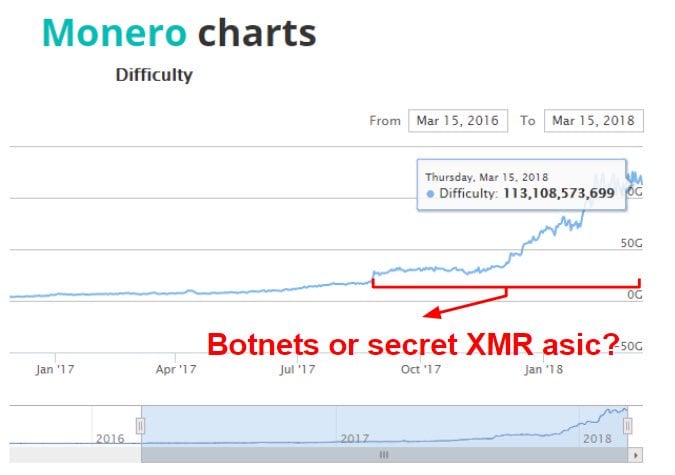
Cryptonight, the chipset fitted to Bitmain’s X3s, has turned into a crypto nightmare for anyone who’s been trying – and failing – to subsist off monero mining this year. As one keen-eyed observer spotted, after Bitmain took possession of the chips, monero’s hashrate rocketed. The monero team, led by Riccardo Spagni, who’s referred to Bitmain as “a known bad actor”, struggled to work out what had happened. A monero mining botnet that had infected millions of computers was one possibility floated, but this was discounted.
To combat the sudden increase in hashrate, Monero announced a PoW change on February 11 to make the privacy coin less susceptible to the Cryptonight algorithm. While not mentioning Bitmain by name, the post noted how “Mining, in general, is also prone to the rich-get-richer effect, which ultimately leads to centralization,” and continued:
We will perform an emergency hard fork to curb any potential threat from ASICs if needed. Furthermore, in order to maintain its goal of decentralization and to provide a deterrent for ASIC development and to protect against unknown or undetectable ASIC development, the Monero team proposes modifying the Cryptonight PoW hash every scheduled fork, twice a year…Finally, we will continue to research alternative Proof of Work functions that may provide better ASIC resistance than Cryptonight.
As a result of the hard fork, the Bitmain X3s will be largely worthless, at least for the purposes of mining monero. All that will be left for recipients of the new X3s is such alts as Bytecoin, Digitalnote, and Darknetcoin: shitcoins to all intents and purposes that cannot be easily offloaded onto the market to offset mining costs.
Battle of the Algorithms: How Bitmain Sparked an ASIC Mining War
Anyone who orders one of Bitmain’s new units will find themselves engaged in a race against time. As one person complained: “Not informing their users that their machine will be useless to mine the biggest and most popular by far crytponight coin is misleading and that is being polite.” By the time they take delivery of their new Antminer, more Cryptonight coins may have hard forked, in which case buyers could wind up lumped with the world’s most expensive doorstop.
Do you think Bitmain has acted unethically, or is it just doing business? Let us know in the comments section below.

Images courtesy of Shutterstock, Bitmain, and Francis Pouliot.
Source : bitcoin.com

Saturday, March 17, 2018

The ‘Mt Gox Whale’ Explains His Crypto-Selling Strategy

On March 17 the Mt Gox bankruptcy trustee Nobuaki Kobayashi revealed some critical information about how he’s been selling the BTC and BCH he has in his possession. The news may comfort those who believe the remainder of the Mt Gox sales will crash the market. According to Kobayashi he has been consulting cryptocurrency experts and selling in a manner that would avoid affecting the market price.

The ‘Mt Gox Whale’ Sold BTC and BCH Between December 2017 and February 2018 on Separate Occasions

The bankruptcy trustee from Tokyo, Nobuaki Kobayashi, is now referred to as the ‘Mt Gox Whale’ on social media and many cryptocurrency centric forums. On Saturday, March 17, the trustee disclosed to the public exactly how he was offloading the cryptocurrencies he holds, as he still has another $1.9 billion worth of BTC and BCH to sell. This massive amount of holdings waiting to be sold has concerned bitcoin traders, because they think the sales could hurt the BTC and BCH market value.
“I sold BTC and BCH from December 2017 to February 2018,” explains Kobayashi in response to questions about the sale.
I sold BTC and BCH separately — Therefore, the total amounts of BTC and BCC sold until the time I ceased selling are different.
The 'Mt Gox Whale' Explains His Crypto-Selling Strategy
Nobuaki Kobayashi has already sold $400 million worth of BTC and BCH. The trustee still has $1.9 billion worth of digital assets left to sell.

Kobayashi Consulted ‘Cryptocurrency Experts’ and Did Not Sell the Cryptos Using an Ordinary Exchange

The 'Mt Gox Whale' Explains His Crypto-Selling Strategy
Nobuaki Kobayashi.
According to the trustee, he consulted “cryptocurrency experts” during the BCH and BTC sales, and he did not use the traditional method of using a digital asset exchange. Further Kobayashi says analyzing the movement of the public addresses is useless, as the assumption that the assets were sold at those exact times is “incorrect.”  
“Following consultation with cryptocurrency experts, I sold BTC and BCH, not by an ordinary sale through the BTC/BCH exchange, but in a manner that would avoid affecting the market price, while ensuring the security of the transaction to the extent possible,” Kobayashi details.   
The method of sale of BTC and BCH was approved by the court as well  — I would like to refrain from explaining the details of the method of sale; otherwise the future sale of BTC and BCH could be hindered  — At present, nothing has been determined regarding the sale of BTC and BCH in the future.
Besides the $1.9 billion worth of digital assets remaining under the trustee’s supervision, he is also supervising the cash collected from the last sale. The approximate holdings of JPY 44,000,000,000 in cash were only recently secured says Kobayashi, and he will determine when creditors will get their restitution settlements in the near future.
What do you think about the Mt Gox trustee’s statements? Do you think his sales affect the open market? Let us know what you think about this story in the comments below.

Images via Shutterstock, Pixabay, and the Tokyo courts. 
Source : bitcoin.com